


When comparing FastAPI vs. Node.js, neither technology is universally better. The right choice depends on your project requirements and your team’s expertise.
FastAPI is usually the better choice for Python teams, data-driven APIs, asynchronous services, and applications that benefit from built-in OpenAPI documentation and strong type validation.
Node.js is typically the better fit for JavaScript or TypeScript teams, real-time applications, projects that rely on the npm ecosystem, and full-stack JavaScript development.
In the Node.js vs FastAPI comparison we’ll do in this article, we’ll examine their architecture, performance, scalability, developer experience, and ideal use cases to help you choose the right backend technology.
- FastAPI is ideal for Python APIs, ML projects, and building automatic API documentation.
- Node.js is the better choice for JavaScript teams, real-time apps, and the npm ecosystem.
- FastAPI can deliver strong performance and fast development for API-focused apps.
- Node.js has a larger library size and provides more flexibility and control.
- Both platforms scale well, but the best choice depends on your stack and project goals.
- Choose FastAPI for Python-first development; choose Node.js for full-stack JavaScript.
- Choosing between FastAPI and Node.js is essentially a language and ecosystem decision.

Try Kamatera's VPS Hosting Free Trial

FastAPI vs. Node.js at a Glance
| Feature | FastAPI | Node.js |
| Primary language | Python | JavaScript / TypeScript |
| Application type | Modern Python web framework | JavaScript runtime environment |
| Best for | APIs, ML backends, data-driven services | Real-time apps, APIs, full-stack development |
| Performance model | Asynchronous (ASGI) | Event-driven, non-blocking I/O |
| Ecosystem | Python packages (PyPI) | npm ecosystem |
| Learning curve | Easy for Python developers | Easy for JavaScript developers |
| API Documentation | Automatic OpenAPI & Swagger docs | Requires third-party libraries |
| Deployment | ASGI servers (Uvicorn, Hypercorn) | Node.js runtime with various hosting options |
Choose FastAPI if:
✓ Your team works with Python
✓ You build APIs, ML applications, or data-driven services
✓ You want automatic validation and API documentation
Choose Node.js if:
✓ Your team uses JavaScript/TypeScript
✓ You build real-time applications or highly interactive services
✓ You want access to the npm ecosystem
What Is FastAPI?
FastAPI is a modern, high-performance web framework for building APIs. It was built to make it easy and fast to create robust, secure, and well-structured APIs in Python. FastAPI uses the standard Python type hints extensively to help developers write code that’s easier to read and maintain while ensuring that performance is maximized.
FastAPI supports asynchronous programming, allowing developers to build non-blocking applications that efficiently handle I/O-bound workloads. Ultimately, FastAPI makes building APIs in Python easier than ever before. It provides developers with modern tooling to quickly create robust and secure web applications that can handle large amounts of data quickly and efficiently.
Looking for Reliable Python Hosting? See Our Top Picks

What Is Node.js?

Node.js is an open-source JavaScript runtime built on Chrome’s V8 JavaScript engine. Instead of running JavaScript only in a web browser, Node.js lets developers execute JavaScript on the server to build APIs, web applications, real-time services, and command-line tools that can handle millions of concurrent connections.
By using an event-driven, non-blocking I/O model, Node.js can efficiently handle many concurrent connections while remaining lightweight and responsive. This makes it particularly well-suited for applications that require fast response times and high concurrency.
Unlike FastAPI, Node.js is not a web framework. It provides the runtime environment needed to execute JavaScript, while developers typically use frameworks such as Express or NestJS to handle routing, middleware, and other web application features.
Because of this, comparing FastAPI and Node.js isn’t a direct framework-to-framework comparison. FastAPI is a Python web framework, whereas Node.js is a platform for running JavaScript or TypeScript on the server. In practice, the decision is often between Python with FastAPI and JavaScript or TypeScript with Node.js.

FastAPI vs. Node.js vs. npm: Understanding the Differences
It’s easy to confuse these technologies because they’re often mentioned together, but they serve different purposes.
- FastAPI is a Python web framework used to build APIs and backend applications.
- Node.js is a JavaScript runtime that allows developers to run JavaScript or TypeScript on the server.
- npm (Node Package Manager) is the default package manager for Node.js, used to install libraries, manage dependencies, and run project scripts.
Because of this, FastAPI vs. npm isn’t a direct comparison. If you’re choosing a backend technology, the more meaningful comparison is FastAPI vs. a Node.js framework such as Express or NestJS, while npm remains the tool used to manage packages in the Node.js ecosystem.
Advantages and Disadvantages of FastAPI
- High Performance
- Developer-Friendly Experience
- Type Safety and Validation
- Native Async Support
- Excellent for Modern APIs
- Python Knowledge Required
- Smaller Ecosystem than Node.js
- Requires External ORM Solutions
- Learning Curve for Beginners
- Less Suitable for Full-Stack Apps
Advantages of FastAPI:
FastAPI is particularly well-suited to Python teams building modern APIs, data-driven services, and AI or machine learning backends.
- High Performance: Built on Starlette and Pydantic, FastAPI delivers strong performance for I/O-bound API workloads while keeping development relatively lightweight.
- Developer-Friendly Experience: Type hints, automatic validation, dependency injection, and interactive API documentation reduce boilerplate and simplify API development.
- Type Safety and Validation: Python type hints and Pydantic models help validate incoming data and catch common problems early in the development process.
- Native Async Support: FastAPI supports Python’s
async/awaitmodel, making it well-suited for applications that handle many concurrent I/O operations. - Excellent for Modern APIs: Built-in OpenAPI support, automatic documentation, and a modular architecture make FastAPI a strong choice for modern APIs and microservices.
Disadvantages of FastAPI:
FastAPI’s flexibility and API-focused design can require more setup for teams that need broader, all-in-one web application features.
- Python Knowledge Required: Developers need a solid understanding of Python, type hints, and concepts such as asynchronous programming to use FastAPI effectively.
- Smaller Ecosystem than Node.js: FastAPI benefits from the broader Python ecosystem, but its framework-specific ecosystem is smaller than Node.js and npm’s.
- Requires External ORM Solutions: FastAPI does not include a built-in ORM, so database access typically requires additional tools such as SQLAlchemy or SQLModel.
- Learning Curve for Beginners: Concepts such as dependency injection, Pydantic validation, and
async/awaitcan take time for developers new to modern Python APIs. - Less Suitable for Full-Stack Applications: FastAPI focuses on APIs rather than complete web applications, so features such as templating, admin interfaces, and authentication often require additional libraries.
Advantages and Disadvantages of Node.js
- High Performance
- Excellent Scalability
- Large npm Ecosystem and Community
- Easy for JavaScript Developers
- Event-Driven Architecture
- Not Ideal for CPU-Intensive Tasks
- Asynchronous Programming Complexity
- Dependency Management Challenges
- Extra Setup for Multi-Core Scaling
- Higher Memory Usage for Large Apps
Advantages of Node.js:
Node.js is a strong choice for JavaScript or TypeScript teams building scalable web applications, APIs, and real-time services.
- High Performance: Node.js combines the V8 JavaScript engine with non-blocking I/O to deliver strong performance for I/O-intensive applications and network services.
- Excellent Scalability: Its event-driven architecture can handle many concurrent connections efficiently, while multiple processes or worker threads can be used when additional CPU capacity is needed.
- Large npm Ecosystem and Community: The npm ecosystem provides a vast selection of packages, libraries, and development tools for building and maintaining Node.js applications.
- Easy for JavaScript Developers: Node.js lets JavaScript developers use the same language on the server that they may already use on the frontend, reducing the need to learn a separate backend language.
- Event-Driven Architecture: Node.js uses an event loop to handle asynchronous I/O without blocking the main JavaScript execution thread, making it well-suited to applications with many concurrent network operations.
Disadvantages of Node.js:
Node.js is highly effective for I/O-bound workloads, but some applications require additional architecture or careful dependency and resource management.
- Not Ideal for CPU-Intensive Tasks: Long-running CPU-bound operations can block the main event loop, so applications with heavy computation may need Worker Threads or separate services to avoid affecting responsiveness.
- Asynchronous Programming Complexity: Promises and
async/awaitsimplify asynchronous code, but applications with complex concurrent workflows still require careful error handling, control flow, and resource management. - Dependency Management Challenges: The large npm ecosystem can introduce security, compatibility, and maintenance risks when projects rely on numerous third-party dependencies.
- Extra Setup for Multi-Core Scaling: A Node.js application running on the main thread does not automatically use all available CPU cores, so multi-process or worker-based architectures may require additional configuration.
- Higher Memory Usage for Large Apps: Large dependency trees, multiple processes, caching, and high concurrency can increase memory consumption, making resource monitoring and optimization important as applications scale.
Security Comparison of FastAPI and Node.js
Both FastAPI and Node.js can be used to build secure applications, but security depends heavily on how the application, dependencies, authentication, and deployment environment are configured. FastAPI provides strong request validation and API security tooling through Pydantic and its Python ecosystem, while Node.js applications typically rely on framework middleware, validation libraries, dependency management, and application-level security practices.
Key security differences include:
– FastAPI provides automatic request validation through Pydantic models, helping developers catch invalid data before it reaches application logic.
– Node.js security relies more heavily on framework choices, middleware, dependency management, and application-level security practices.
– Both platforms support common security measures such as authentication, HTTPS, access control, and protection against common web vulnerabilities.
| Security Area | FastAPI | Node.js |
| Input validation | Pydantic models provide automatic request validation and type checking | Requires framework or third-party validation libraries |
| Authentication | Provides utilities for integrating OAuth2, API keys, and other authentication schemes | Commonly implemented through framework middleware and authentication libraries |
| API documentation | OpenAPI documentation is generated automatically | Usually requires framework support or third-party tools |
| CSRF protection | Depends on the authentication method and application architecture | Typically handled through framework middleware or third-party libraries |
| Rate limiting | Usually implemented through middleware or external services | Usually implemented through middleware or third-party packages |
| Dependency security | Python packages should be reviewed and monitored for vulnerabilities | npm dependencies should be reviewed, updated, and audited for vulnerabilities |
| HTTPS/TLS | Typically configured through an ASGI server or reverse proxy | Supported through Node.js TLS APIs or commonly handled by a reverse proxy |
Performance Comparison of FastAPI and Node.js
When comparing the performance of FastAPI and Node.js, it’s important to look beyond raw benchmarks. The better choice depends on your application’s workload, architecture, database interactions, and the efficiency of the code’s implementation. Here are three key metrics to consider.
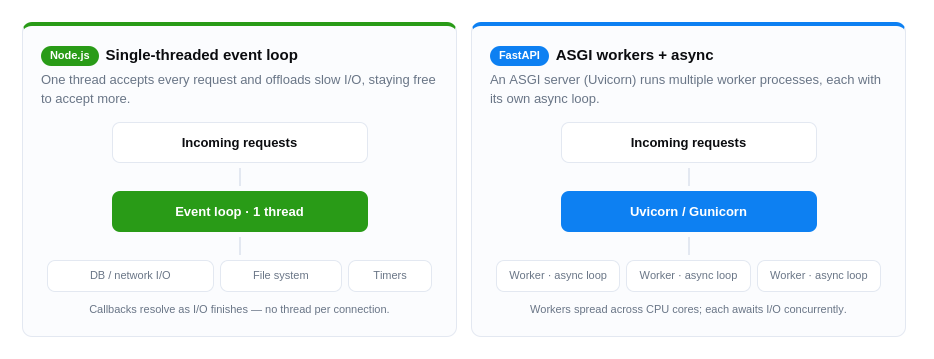
The practical difference: Node.js is particularly well-suited to high-concurrency I/O workloads because of its event-driven, non-blocking architecture. FastAPI can also handle high concurrency for I/O-bound workloads through asynchronous execution and can use multiple worker processes to take advantage of multiple CPU cores.
| Metric | Node.js | FastAPI |
| Simple-JSON throughput | Fastify is among the fastest of any runtime; Express is modest | Competitive once run with multiple Uvicorn workers |
| Latency under load | Very low and consistent; strong at tail latency | Low; Pydantic request validation adds some processing overhead |
| Memory baseline | ~40-80 MB for a simple app. | ~80-120MB, predictable under sustained load. |
| Serverless cold start | Comparable – typically sub-2s; varies with bundle size. | Comparable – typically sub-2s; varies with bundle size. |
| Sweet spot | Real-time, I/O-heavy, full-stack JavaScript apps. | Async APIs, data-heavy and AI/ML backends. |
1. Speed
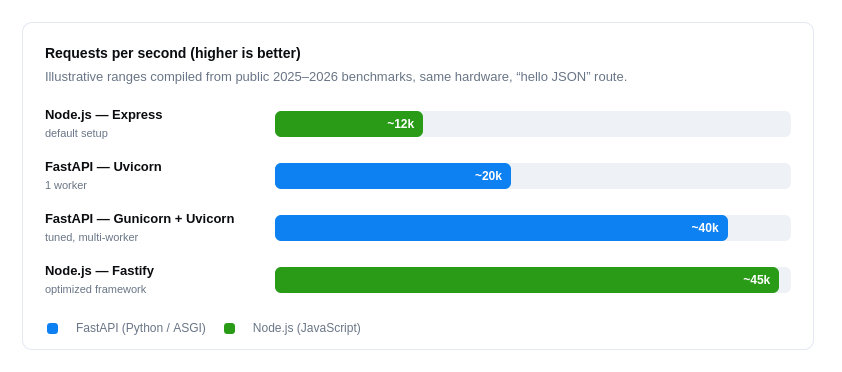
FastAPI is known for its impressive performance when building asynchronous Python APIs. Running on an ASGI server such as Uvicorn, it can handle a high volume of requests efficiently while benefiting from automatic validation and Python type hints.
Node.js also delivers excellent performance, particularly for I/O-intensive applications. Its event-driven, non-blocking architecture makes it well-suited for APIs, real-time applications, streaming services, and workloads that spend most of their time waiting for network or database operations.
Rather than having a universal winner, the faster option depends on the workload. CPU-intensive tasks, database performance, caching, and application design often have a greater impact than the choice between FastAPI and Node.js itself.
2. Memory Usage
Memory usage depends heavily on the application architecture, dependencies, and workload. Both FastAPI and Node.js can be optimized to run efficiently in production environments.
FastAPI applications are generally memory-efficient, especially for API-focused workloads. Python’s modern async ecosystem allows applications to handle many concurrent requests while keeping resource usage under control.
Node.js is also highly memory-efficient, particularly for long-running network services. Since it uses a lightweight event loop instead of creating a thread for every connection, it can serve many simultaneous clients with relatively modest memory requirements.
In practice, memory usage is influenced more by application design, dependency choices, and workload than by the framework or runtime alone. Poor resource management can increase memory consumption regardless of which technology you choose.
3. Development Speed
FastAPI emphasizes developer productivity through automatic request validation, type hints, dependency injection, and interactive API documentation generated from the code. These features reduce boilerplate and make it possible to build and maintain APIs quickly.
Node.js offers a mature ecosystem with millions of npm packages and several well-established frameworks such as Express and NestJS. While developers may spend more time selecting libraries and defining project architecture, they also benefit from exceptional flexibility and a vast ecosystem. And when best practices are followed, Node.js development can become highly efficient due to its mature ecosystem and extensive tooling.
Ultimately, development speed depends largely on your team’s experience. Python developers often become productive quickly with FastAPI, while teams already familiar with JavaScript or TypeScript may deliver features just as rapidly using the Node.js ecosystem.
Development Experience With FastAPI and Node.js
When comparing the development experience of FastAPI and Node.js, there are several factors to consider, including the learning curve, documentation, ease of use, and available tools and libraries.
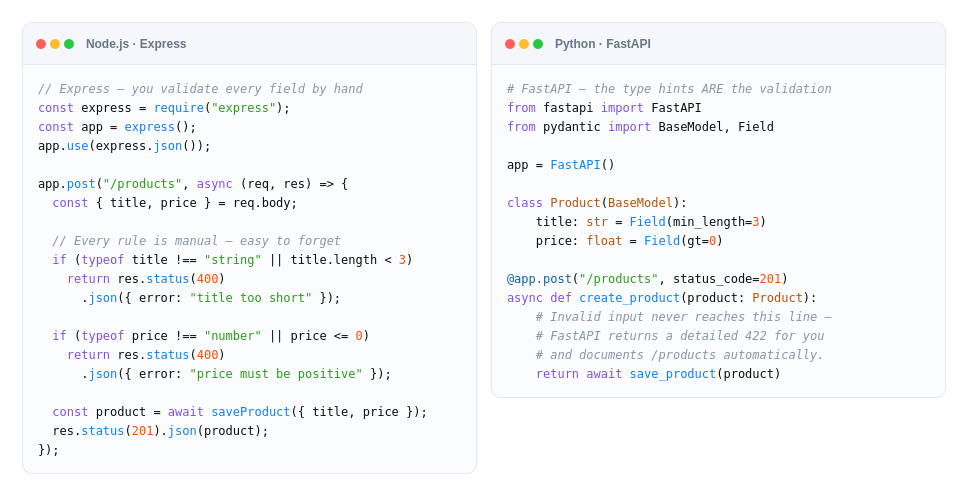
| Node.js – Express | Python – FastAPI |
// Express — you validate every field by handconst express = require("express");const app = express();app.use(express.json());app.post("/products", async (req, res) => {const { title, price } = req.body;// Every rule is manual — easy to forgetif (typeof title !== "string" || title.length < 3)return res.status(400).json({ error: "title too short" });if (typeof price !== "number" || price <= 0)return res.status(400).json({ error: "price must be positive" });const product = await saveProduct({ title, price });res.status(201).json(product);}); | # FastAPI — the type hints ARE the validationfrom fastapi import FastAPIfrom pydantic import BaseModel, Fieldapp = FastAPI()class Product(BaseModel):title: str = Field(min_length=3)price: float = Field(gt=0)@app.post("/products", status_code=201)async def create_product(product: Product):# Invalid input never reaches this line —# FastAPI returns a detailed 422 for you# and documents /products automatically.return await save_product(product) |
- Express gives you full control and full responsibility — you own every check, message, and response shape.
- FastAPI turns the same rules into a Pydantic model: invalid input is rejected with a detailed 422 before your handler runs.
- Node.js trades boilerplate for flexibility; FastAPI trades flexibility for speed of delivery.
1. Learning Curve
Regarding the learning curve, FastAPI is usually easier for developers familiar with Python, while Node.js is often more approachable for JavaScript developers who want to use the same language across frontend and backend.
For developers with no prior experience in either ecosystem, the learning curve will depend largely on familiarity with Python or JavaScript concepts and with asynchronous programming, although FastAPI may feel slightly more straightforward.
2. Documentation
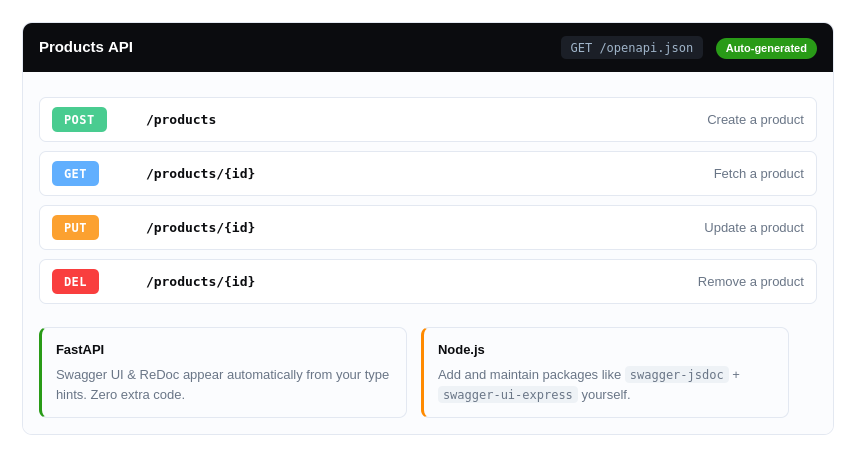
Developing quickly and efficiently requires an organized, comprehensive documentation system. FastAPI and Node.js have done well in this regard, with FastAPI providing explicit examples and code snippets to make getting up and running smoother. On the other hand, Node.js offers many features and modules, which can sometimes feel overwhelming due to the sheer volume of information. However, its documentation is still thorough and well-organized.
3. Ease of Use
If you’re looking for an easy-to-learn, straightforward option for creating APIs, FastAPI is a great choice. It offers intuitive features such as automatic data validation and OpenAPI documentation, making it a popular choice for developers of all levels. On the other hand, Node.js may require more time to learn but provides more flexibility and control over the application’s architecture.
4. Available Tools and Libraries
FastAPI and Node.js provide developers with different levels of development experience. With FastAPI, developers can benefit from the powerful data validation and routing capabilities provided by Pydantic and Starlette. Meanwhile, Node.js allows for quick access to a variety of library packages as well as effortless installation of any dependencies via npm. As such, developers can choose the best technology stack that suits their needs.
When to Choose FastAPI
FastAPI is often the better choice if your team:
- Already works primarily with Python.
- Builds APIs for machine learning, data science, or AI applications.
- Wants automatic request validation and interactive API documentation.
- Prefers type hints and modern Python features to improve code quality.
When to Choose Node.js
Node.js may be a better fit if your team:
- Primarily develops in JavaScript or TypeScript.
- Wants to use the extensive npm ecosystem and its wide range of packages.
- Builds full-stack JavaScript apps with shared code between frontend and backend.
- Frequently develops real-time applications such as chat platforms or live dashboards.
FastAPI and Node.js Alternatives: Express, NestJS, Flask, and Django
While FastAPI and Node.js are often compared directly, developers may also consider other frameworks depending on their technology stack.
If you are looking for a Node.js-based alternative to FastAPI, the most common comparisons are FastAPI vs. Express and FastAPI vs. NestJS. Express is a lightweight and flexible framework, while NestJS provides a more structured architecture for building larger Node.js applications.
Within the Python ecosystem, FastAPI is more commonly compared with Flask and Django. Flask offers a minimal and highly customizable approach, while Django is a full-featured framework designed for larger applications with built-in functionality.
The best choice depends on your preferred programming language, project requirements, and the level of structure your application needs.
Conclusion
FastAPI and Node.js are both powerful options for modern web development, but the right choice depends on your project requirements, team expertise, and preferred ecosystem.
For Python-first teams, API-focused projects, and applications that benefit from Python’s data science and machine learning ecosystem, FastAPI is often the cleaner, natural choice. Its built-in validation, automatic documentation, and high performance make it especially suitable for building modern APIs quickly.
For JavaScript or TypeScript teams, real-time applications, and projects that require a full-stack JavaScript workflow, Node.js is usually the more practical option. Its large ecosystem, extensive package availability through npm, and flexibility make it especially suitable for scalable web applications and real-time services.
In the end, the FastAPI vs. Node.js decision is not about which technology is universally better. The best choice is the one that matches your team’s skills, application requirements, and long-term development goals.

Next Steps: What Now?
- Research Node.js Hosting Providers: Choose a hosting provider that offers robust support for Node.js, ensuring optimal performance and reliability.
- Keep Up with Node.js Updates: Regularly update your Node.js version to take advantage of performance improvements, new features, and security patches.
- Explore Node.js Libraries and Frameworks: Expand your development toolkit to enhance your application’s functionality and efficiency.
- Connect with the Node.js Community: Join online forums, attend meetups, participate in conferences, and stay informed about best practices and emerging trends.
Learn More About Node.js
- Node.js Pros and Cons
- What Is a Node.js Server?
- How to Run a Node.js Server
- How to Host a Node.js Server
- Node.js vs. Python
- Node.js vs. Java
- Node.js vs. JavaScript
- Node.js vs. React.js
- Express.js vs. Node.js
- NestJS vs. Node.js
- Deno vs. Node.js
- Node.js vs. Vue.js
- Node.js vs. NPM
- Node.js vs. Flask
- Node.js vs. Spring Boot
- Node.js vs. Golang
- Node.js vs. Angular


