


Lovable has earned its place as one of the most approachable AI app builders in the market.
With its conversational interface, full-stack code generation, and native integrations with Supabase and Stripe, it’s become a go-to tool for non-technical founders, designers, and small teams looking to turn ideas into working prototypes fast.
But Lovable is not the perfect fit for everyone. In this guide, we’ll analyze the best Lovable alternatives to help you find the right tool for your project.
Discover Top 5 Lovable Alternatives
| Provider | User Rating | Recommended For | |
|---|---|---|---|
 | 4.7 | Building cross-platform mobile apps with “vibe coding” | Visit Emergent |
 | 5.0 | Best for rapid prototypers who need working apps in under 10 minutes | Visit Base44 |
 | 5.0 | Simple yet functional applications without coding. | Visit Hostinger Horizons |
 | 5.0 | Production-grade applications with broader control and flexibility | Visit Bubble |
 | 4.0 | Small businesses looking to build simple business applications from a single platform. | Visit GoDaddy Airo |
1. Emergent

| EMERGENT FEATURES | Details |
|---|---|
| AI Model | Claude 4.0 Sonnet (Default), GPT-5 (Beta), Ultra Thinking |
| Free Trial | 5 credits per month; no credit required for initial tryout |
| Starting Price | $20/month (Standard); Comes with 100 credits |
| Tech Stack | React (Frontend), Fast API (Backend), PostgreSQL/MongoDB; Browser-based VS Code editing. |
| Deployment | One-click hosting to Emergent subdomains; custom domain available on paid plans; GitHub Export available |
| Overall Performance | Generates production-ready architecture with automated testing and managed infrastructure; built for complex full-stack projects. |
| Best Use Cases | Full-stack MVPs, prototypes, and complex applications. |
Why Emergent Stands Out as a Better Lovable’s Alternative
Lovable and Emergent are impressive AI-app builders that can be used to create applications. However, each tool has its own strengths and limitations. While they both support the production of applications using prompts, the difference is, however, in their setup.
Emergent Builds the Entire Application Within Minutes, Not Just The Frontend
Lovable allows users to build a polished React frontend application. However, backend functionality (Supabase) must be integrated externally into the platform. On the other hand, Emergent handles everything automatically.
With just a push of a button, you’ll get frontend, backend, database, and authentication in a single output. It also automates Stripe payment in test mode and inputs the necessary API keys for you.
It Uses a Multi-Agent Generation System
Emergent uses a multi-agent approach to engineer applications from start to finish. There can be one agent for the frontend, another for the backend, and another for tests.
This approach sets it apart from other app builders. It creates a sense of team collaboration across the journey.
VS Code for Editing
Compared to Lovable, which only allows code edits on paid plans, Emergent offers a full browser-based VS Code editing setup. In the code editor, you’ll get the complete codebase, from backend to frontend code files.
Here, you can read, edit, and debug the entire codebase manually or using the AI-designed prompts.
Code Ownership Starts From You
Emergent doesn’t trap you in its infrastructure. Code ownership is a core feature of the tool. You can easily export your code to GitHub (just like Lovable) or move further to self-host on platforms like AWS, Vercel, or DigitalOcean.
The exported output is usually well-structured enough for any developer to pick it up and use it further for other purposes.
Key Strengths
- Builds full-stack applications from prompts or code editing
- Runs multiple AI-agent systems
- Full browser-based VS Code is available for all users
- Automated testing environment
- No vendor lock-in
- One-click deployment
- Custom domain support (optional)
Potential Limitations
- No drag-and-drop visual editor
- Free tier’s credit is not sufficient
- Limited Flexibility
Lovable vs Emergent AI: Key Differences & Similarities
| Feature | Emergent | Lovable |
|---|---|---|
| Primary User | Individuals looking to build full-stack apps without coding. | Individuals looking to build fully functional apps, and still get a little flexibility. |
| How It Builds | Prompt-based: Multiple AI agents work together to bring your prompt to life. | Prompt-based; One AI agent working to actualise the prompts. |
| Backend Integration | Automate Backend; Database, Testing, APIs, and Strip are automatically set up. | Requires manual connection to Supabase |
| Tech Stack | React + FastAPI + PostgreSQL or MongoDB | React + TypeScript + Tailwind CSS |
| Code Access | VS Code Editor is available to all users | View-only in browser; edit access requires a paid subscription |
| Collaboration | GitHub sync; no real-time co-editing | Unlimited collaborators; real-time editing in beta |
| Deployment | Netlify integration, Bolt hosting (.bolt.host), or manual GitHub deployment | Export code and self-host on Netlify, Vercel, or Cloudflare Pages. |
| Publishing | One-click publishing to Emergent’s subdomain; custom domain available | One-click to lovable.app subdomain; GitHub sync for custom hosting |
| Pricing | $20 per month | $25/month (credit-based) |
Lovable vs Emergent: Bottom Line
If you want a tool that can produce a full-stack application without requiring manual setup, Emergent is one of your best options. However, Lovable still provides a simpler, more guided experience.
From Lovable’s visual editor to real-time collaboration features, it is a best fit for product managers, developers, founders, and small teams.

Building cross-platform mobile apps with “vibe coding”
2. Base44

| BAse44 features | Details |
|---|---|
| AI Models | Gemini 2.5 Pro, GPT-5, Claude Sonnet 4.5, plus external API connections (OpenAI, Groq, Mistral) |
| Free Plan | 25 message credits/month, 100 integration credits, public projects |
| Starting Price | $16/month (Starter plan, annual billing) |
| Tech Stack | JavaScript with automated error correction; backend dashboard integration |
| Deployment | One-click publishing to base44.app subdomains with automatic hosting and scaling |
| Collaboration | Multi-user editing with real-time collaboration |
| Overall Performance | Designed for speed over sophistication; generated working apps within 10 minutes with automatic hosting and scaling. |
| Best Use Cases | Prototypes and solo projects/websites |
Why Base44 Excels at Lightning-Fast Prototyping
Unified Approach
What makes Base44 particularly compelling for non-technical founders is its unified workflow that eliminates decision fatigue. Unlike Lovable’s layered approach (prompts vs. visual editor vs. code), Base44 treats every customization method as a variation of the same tool.
Whether you’re typing natural language prompts, clicking elements to adjust properties, uploading inspiration images, or applying styling presets like Neo-Brutalism or Glassmorphism, everything flows together without mode-switching.
This integrated approach means beginners never have to decide “should I use prompts or the visual editor for this change?” They simply make changes, and the AI understands their intent regardless of the input method.
It Handles Everything Automatically
The all-in-one infrastructure approach further reduces complexity. Base44 automatically handles hosting, database setup, authentication, and scaling without requiring external service configuration.
Key Strengths
- Fast app-generation speed at 6 minutes.
- Automatic error detection and recovery.
- Unified workflow setup
- One-click deployment with instant publishing
- Automatic hosting/scaling
- 100+ community templates for quick ideas
- Built-in backend Setup
Potential Limitations
- Only ~15 pre-built options vs Lovable’s 100+ verified integrations
- Vendor lock-in on proprietary backend
- Export-only on GitHub integration without bi-directional sync
- Less sophisticated code generating JavaScript instead of TypeScript, with less organized architecture
- Backend functions are gated behind paid plans
- Offers a per-account pricing ($16-160/monthly) vs Lovable’s unlimited team collaboration.
Base44 vs Lovable: Key Differences & Similarities
| Feature | Base44 | Lovable |
|---|---|---|
| Primary Focus | Ultra-fast prototyping with automatic error recovery | Production-ready full-stack apps with superior code quality for teams |
| Code Architecture | JavaScript with flat structure and backend dashboard integration | Production-grade React + TypeScript with an organized folder structure |
| Error Handling | Automatic correction mid-build without user intervention | “Try to fix” button with guided explanations and manual approval |
| Code Access | Read-only free; export on paid plans (Builder tier $40/month+) | Read-only free; GitHub export always available; editing on paid plans |
| AI Model | Gemini 2.5 Pro, GPT-5, Claude Sonnet 4.5, external API connections | Gemini 2.5 Flash (default), GPT-5, multiple Gemini variants (7 models) |
| Customization Approach | Unified workflow where all methods integrate seamlessly | Layered approach: prompts, visual editor, or direct code editing |
| Integrations | ~15 pre-built integrations; custom APIs via backend functions (paid) | 100+ verified integrations with native Supabase and Stripe connections |
| Backend Infrastructure | Proprietary automatic database with built-in management dashboard | Native Supabase (PostgreSQL) or Lovable Cloud with auto-scaffolding |
| Deployment | One-click to base44.app subdomain with automatic hosting | One-click to lovable.app subdomain; GitHub sync for Vercel/Netlify/Pages |
| Custom Domains | Builder plan+ ($40/month); can purchase through platform via IONOS | Pro plan+ ($25/month); automatic SSL setup via Entri integration |
| GitHub Integration | Export-only on paid plans; no bi-directional sync | Bi-directional sync enabling seamless external development workflows |
| Mobile Deployment | PWA + complex Capacitor wrapping with backend migration required | PWA + GitHub export for standard mobile development workflows |
Base44 vs Lovable: Bottom Line
Base44 is the ideal Lovable alternative for solo non-technical founders who prioritize validation speed over code sophistication.
If you need to test business ideas in under 10 minutes without learning infrastructure concepts, Base44’s 6-minute generation time, automatic error recovery, and one-click deployment with zero external service configuration make it unbeatable for rapid prototyping.

Rapid prototypers who need working apps in under 10 minutes
3. Hostinger Horizons

| HOSTinger horizons features | Details |
|---|---|
| AI Model | Proprietary AI-powered tool (no model selection) |
| Free Trial | Yes (Comes with 5 free messages per day); No credit card required for initial tryout. |
| Starting Price | Explorer (RM 43.99 or $6.99/Per Month) |
| Tech Stack | AI-generated frontend; Integrates with Supabase and Stripe |
| Deployment | 1-click publishing; Custom domain support |
| Overall Performance | Beginner-friendly hosted platform; handles deployment and backend automatically; best suited for non-complex websites and applications. |
| Best use cases | Websites, landing pages, etc., interactive web apps such as budget trackers, and product dashboards. |
How Hostinger Horizons Stands Out as a Beginner-Friendly Alternative
Lovable and Hostinger Horizons have varying philosophies.
Simple Workflow
With Lovable, you can create working applications using real, editable code files on the platform, and even move further to integrate with developer workflows such as GitHub, Stripe for payments, and Supabase for databases.
On the other hand, Hostinger Horizons is built for people who’d like to build applications without writing any code. It’s like having a conversation with a developer and watching it build everything for you. You can describe your idea in plain language and watch Horizons build everything for you, from layouts to UI, fonts, styling, and more.
Faster Deployment Setup
One thing that differentiates Horizons from Lovable is the deployment setup. It’s quite easy to deploy an application on Horizons because the necessary tools are already integrated into the workflow. All you need to do is hit “Publish” and you’re good to go. By contrast, Lovable requires more manual setup with apps being deployed through GitHub and hosted externally.
Horizon’s Bundled Value
The bundled value on Horizons is also a key differentiator. Every paid plan comes with a set of additional features (features that are usually handled separately), such as a custom domain, business email, hosting, security features, etc.
These bundled values are available on all paid tier plans; the only difference is the varying message tokens between the plans. Horizons pricing starts from $6.99 – $79.99/month.
On the other hand, Lovable structures its pricing on credits, which act as tokens on the platform. It starts from $25 per month with a separate service infrastructure for different pricing tiers.
Key Strengths
- No coding experience required.
- Offers an all-in-one package for paid tier users.
- Provides an interactive live preview feature
- Built-in error detection and debugging features.
- Supports over 80 languages for prompts.
- No credit card required for the free trial.
Potential Limitations
- No codebase access.
- Supports manual Supabase connection.
- Higher-tier plans are required to access larger message tokens.
Hostinger Horizons vs Lovable: Key Differences & Similarities
| Feature | Hostinger Horizons | Lovable |
|---|---|---|
| Primary Focus | An all-in-one tool for non-technical users with bundled values. | Chat-based AI builder with editable code access. |
| AI Approach | Chat-based generation with real-time build logs and transparency | Chat-based generation with less visible scaffolding process |
| Backend Development | Requires manual setup for auth and database; Stripe for payments | Connects to Supabase natively for auth, schemas, and security; Stripe for payments. |
| Tech Stack Flexibility | AI-generated; not exportable | Primarily React and TypeScript with Tailwind CSS; Exportable via GitHub |
| Customization Approach | Real-time preview; Prompt-based customization; Drag-and-drop builder | Visual editor for UI tweaks; prompts for broader design changes |
| Collaboration | Up to 50 projects allowed; individual users with sequential editing | Unlimited collaborators with beta real-time collaboration features |
| Deployment | One-click publishing; custom domain available on paid plans | One-click publishing to lovable.app subdomain; GitHub sync available |
| Free Trial | 5 messages per day; no credit card required for setup. | Limited daily credits; public projects only; no credit card required. |
Lovable vs Hostinger Horizons: Bottom Line
Hostinger Horizon is the best choice if you’re a non-technical builder with little to no coding experience, and you want to build a functional website or interactive applications with fewer technical functionalities.
But best to pick Lovable if you want a level of technicality when building applications. In other words, you need a tool that can write code from scratch while offering you the flexibility to edit the same code as you desire.
You also prefer the ability to export output to GitHub, extend the app, or even import Figma files to the platform.
Simple yet functional applications without coding
4. Bubble

| Bubble features | Details |
|---|---|
| Best Use Cases | To build SaaS tools, marketplace apps, internal tools, MVPs, and more. |
| AI Model | Proprietary AI (no model selection) |
| Free Trial | Available; Limited to certain features and deployment. |
| Starting Price | Starter ($29/month) |
| Tech Stack | Visual drag-and-drop builder; Built-in database |
| Performance | Built to produce more than just a prototype; Designed to scale; Requires a level of mastery and learning. |
| Overall Verdict | Bubble is one of the oldest no-code builders. While it takes a different approach, it’s a great tool for building applications with advanced workflow and pixel-perfect designs. |
Why is Bubble a Suitable Alternative to Lovable?
Both platforms let you build applications without coding. However, they take different approaches. Lovable is built more for speed; describe your idea and get an output.
While Bubble offers control, you can design your screen, define your workflow, and scale as needed.
Bubble is a True Drag-And-Drop Editor, Not Just AI Prompts
Bubble offers a full visual editor experience by allowing users to click directly on elements and customize it as needed. You can drag elements onto a canvas, resize the components, set alignment rules on different devices, and more. You can also use plugins to assign CSS classes to elements. If you’re looking for a pixel-perfect design, Bubble gives you control that Lovable simply doesn’t.
Built-in Backend Support
The backend feature on Bubble is built into the system. With the click of a button, you can set up your data types, privacy rules, connect API, and manage your database. You can handle all of these in the same editor. You do not have to manually connect different services externally, as seen in Lovable.
Offers 6000+ Plugin Options in the Marketplace
Plugins are add-ons for Bubble that help extend the tool’s capabilities. With over 6,000 plugins to choose from, you can get almost everything you need to extend or customise your application to suit your desires. You can’t find what you need? Bubble allows you to create and publish your own plugin to the marketplace. This feature is one of the most important services that sets Bubble apart from other no-code app builders.
Bubble Handles Errors Tactically
While other no-code tools require you to fix errors using AI prompts, Bubble goes much deeper. It provides a step-by-step debugger that allows you to inspect every action one by one. At every stage of production, you’ll be able to know if the workflow is properly defined and applied. This feels just like how a developer would inspect errors in a traditional IDE. Plus, you can set up a custom error message, identify errors/failures, and log these errors to the database for review.
Bubble is Built for Scale
Bubble is designed for complex and advanced workflow management, specifically for enterprise users with high traffic loads. The tool also offers services such as custom workload units, uptime SLAs, dedicated servers, and more to help deal with heavy users.
Key Strengths
- Full drag-and-drop visual builder
- 6000+ plugins options
- Built-in backend and database connection
- No coding required to start
- Responsive device application
- Version control
- No coding required for free trial
- Visual workflow builder for app logic
Potential Limitations
- Deployment requires a paid plan
- Requires a certain level of mastery and familiarity
- No code export available
- Usage-pricing may be unpredictable
Bubble vs Lovable: Key Differences & Similarities
| Feature | Bubble | Lovable |
|---|---|---|
| Primary Focus | Drag-and-drop visual editor with AI-assisted generation. | AI-chat-based prompts to build applications. |
| Application Support | Web and Native application | Web applications only |
| Design Integration | Pixel-perfect drag-and-drop with a responsive engine and global styles | Visual editor + Figma import + AI prompts |
| Code Access | Not supported | Allows full export to GitHub on paid plans |
| Publsihing | Deploy in editor; custom domain available | One-click publishing; custom domain available |
| Free Trial | Full builder access; no publishing; no credit card needed | Limited daily credits; no credit card required; public projects only |
| Pricing | Starts at $29/month (usage-based) | Starts at $25/month (credit-based) |
Lovable vs Bubble: Bottom Line
If you’re building something that needs to scale, requires complex logic, or a pixel-perfect visual, Bubble is a great long-term solution.
However, if you want more hands-on features such as code export, Figma import, accessibility, etc., Lovable is a great match.

Production-grade applications with broader control and flexibility
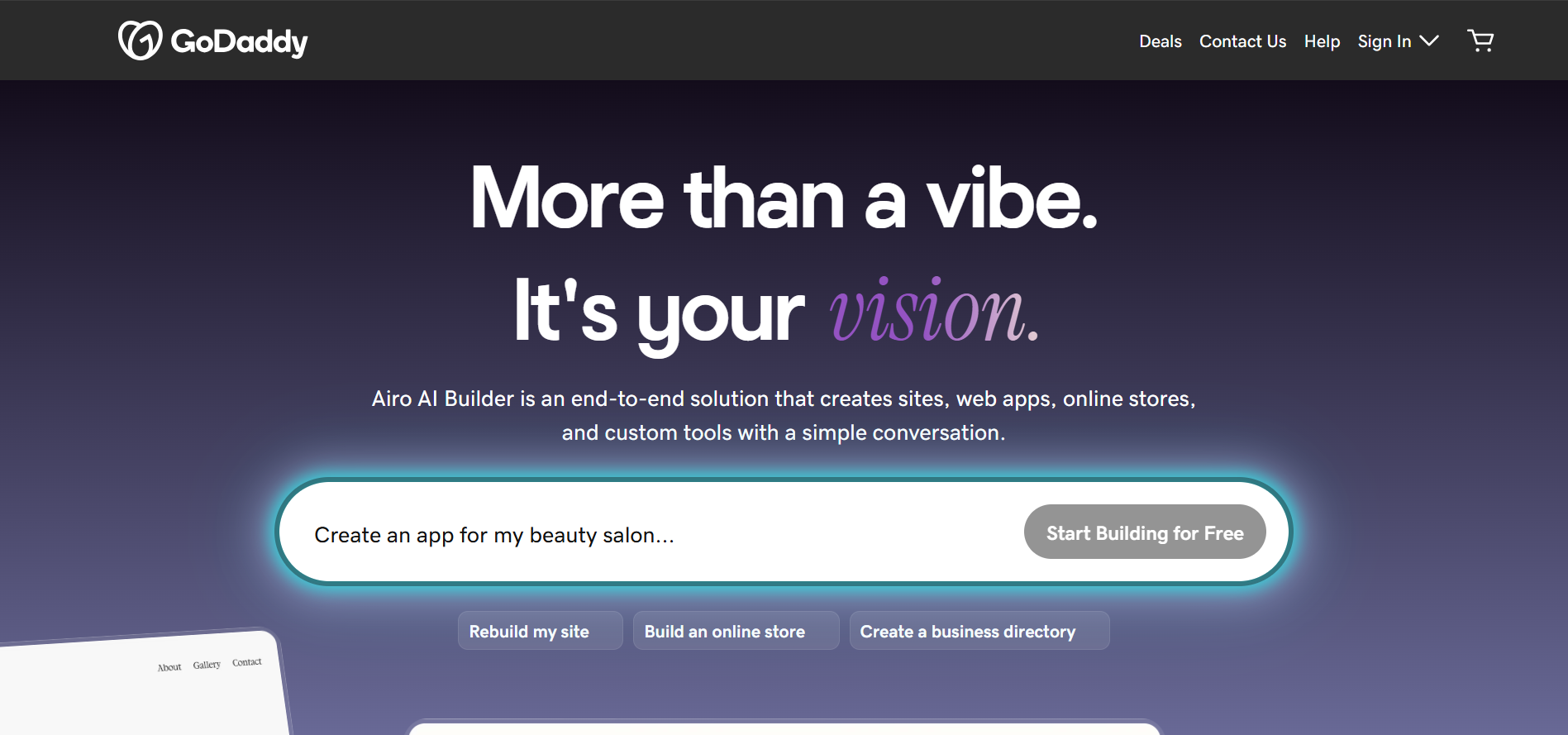
5. GoDaddy Airo
| GoDaddy Airo features | Details |
|---|---|
| AI Models | Proprietary AI |
| Free Trial | Yes (50 AI credits/month) No credit card required |
| Starting Price | $9.99/€8.49 (Billed annually) |
| Deployment | One-click publish to GoDaddy’s hosting |
| Built-in Tools | Logo maker, “Write It For Me” copywriting, Content creator, Social media scheduler, Booking system, SEO wizard, AI product listing, Email marketing, etc. |
| Core Strength | Simplest path from live website to domain authorization; cheaper entry to AI website app builder; Built on a solid and reliable infrastructure |
| Best Use Cases | Simple business websites, dashboards, & portfolios. |
How GoDaddy Stands Out Compared to Lovable
Both Lovable and GoDaddy Airo use artificial intelligence (AI) to help users create applications without the need to code. However, the difference between the two platforms lies in the process and purposes.
Built for Businesses, Not Builders
While both tools can be used to create applications, they are, however, designed differently and for varying purposes. Lovable is built to enable tech-savvy users, founders, and developers to create custom applications with production-ready code while gaining full control.
On the other hand, GoDaddy Airo is more business-focused; an all-in-one platform to help business owners get online as quickly as possible. It’s user-friendly and designed best for non-technical users who want the quickest way to launch simple applications.
In other words, lovable requires a bit of technical knowledge to manage, while GoDaddy Airo can be used by anyone.
All-In-One Business Suite
Lovable focuses on seamless app generation. From editable React and Typescript code to Figma import, everything is coordinated and synced.
GoDaddy Airo also provides app generation features but with additional bundled benefits, including: email marketing, social media scheduling, appointment booking, an SEO Wizard, and a Content Creator.
These additions make it easier for business owners to launch their products seamlessly while also managing their marketing under a single platform. It’s an all-in-one package. From hosting to domain and marketing, everything is embedded on GoDaddy Airo.
Speed Over Depth
GoDaddy Airo has to be one of the fastest AI app builders I’ve ever tested. It delivered a working business website in under two minutes. However, the tradeoff is the depth.
While GoDaddy Airo produces one of the fastest AI-generated results, it however needs specific revision before it can be properly used. For one, the AI-generated copy was too generic, the use of stock images made the website look ordinary, and the editor did not have a drag-and-drop function.
But by contrast, Lovable produces real React + TypeScript code that developers extend, export, and deploy anywhere.
24/7 Support
Unlike most app builders, GoDaddy Airo offers 24/7 phone and live chat support for its users on all tiers. This means you do not have to be a premium user to reach out to the support team at GoDaddy Airo.
Lovable’s support system, on the other hand, includes documentation resources, Discord community, and email. Unlike Airo, they do not have a phone line that you can simply call for assistance.
Affordable Entry Point
With GoDaddy Airo, you get a ‘7-day free premium’ trial. This trial period gives you access to all the premium functionalities of the platform. If you’re a business owner looking for a quick way to create your website, this gives you a free pass to get what you need without necessarily paying.
Aside from that, the free version on GoDaddy Airo also gives out 50AI credits per month. With these credits, you can freely use the platform anytime to create simple websites or applications.
In contrast, the starting price for GoDaddy Airo begins from $9.99 (when billed annually, but up to $19 when billed monthly), while Lovable starts from $25. GoDaddy Airo offers a lower entry cost compared to Lovable.
Key Strengths
- No coding required. App generation from prompts.
- Usable free plan without time limits
- Fast app generation process – under a few minutes
- Include additional built-in tools– logo maker, SEO wizard, content creator, email marketing, custom domain, etc.
- Great for e-commerce businesses
- Live theme previews with your actual content
- Simple to navigate and manage for non-technical users
- Competitive pricing
- 24/7 phone, live chat, and Discord community support
- Built on GoDaddy’s ecosystem, i.e., world-class support, 99.9% uptime, etc.
Potential Limitations
- Generated content is overly generic and unoriginal
- New to the app-building industry
- No drag-and-drop builder available
GoDaddy Airo vs Lovable: Key Differences & Similarities
| Feature | GoDaddy Airo | Lovable.dev |
|---|---|---|
| Primary User | Simple business websites, dashboards, portfolios, and booking platforms | Websites, web applications, SaaS products, MVPs, etc. |
| AI Approach | Guided questionnaire + inline AI copywriting | Chat-based prompt generation |
| Starting Price | €8.49 ($9.99)/month or €16.99 ($19.36)/month (billed annually) | $25/per month |
| Free Trial | 50 AI credits per month | 5 credits daily (capped at 30 per month) |
| Ease of Use | Very beginner-friendly; best for non-technical users | Easy to use; unless you want to dive into the advanced functionalities (requires basic technical knowledge) |
| Deployment | One-click publish to GoDaddy’s subdomain; custom domain on paid plans | One-click to lovable.dev subdomain; custom domain on paid plans |
| Backend & Integration | Built-in database and backend support; has less depth than Lovable | Supabase integration for auth and database |
| Code Ownership | Code can be downloaded on all plans; no-platform lock-in | Export code to GitHub; Deploy to Vercel or Netlify; no platform lock-in |
| Speed | Fast – under a few minutes | Basic – minutes to hours depending on complexity |
| Mobile/Web Support | Web-based only | Web and mobile app available |
GoDaddy Airo vs Lovable.dev: Bottom Line
If you need a business website running today and with minimal effort, GoDaddy Airo is your best bet. With additions such as email marketing, SEO Wizard, etc., you can handle your entire business in one place.
However, if depth and better functionalities matter more to you than speed, Lovable is a great match. It’s a great way to create fully functional products and applications (web app, SaaS tool, client portal, etc) without going through the traditional coding route.

Create Your Business Site Using GoDaddy Airo
How to Choose the Right Lovable Alternative
Choosing the right Lovable’s alternative depends on your building objective, the size of your team, and how you build.
While Lovable stands out as a formidable AI app-building tool, every other platform listed in this guide excels for specific reasons, and here’s why.
1. Check Your Technical Comfort Level
If you’re a non-coding user but need to build a working application fast, Lovable and Hostinger Horizons are your best bet.
These tools allow you to build applications from natural language prompts, thereby making it easy for non-technical users to build without going through the hassle of writing endless lines of code. Base44 and GoDaddy Airo are also good options if speed is essential for you.
To take it further, Hostinger Horizons also offers a bundled value that includes a custom domain, business email, etc., in every paid plan. This makes it easy for you to build a functional app while skipping the usual manual setup process, something Lovable does not have.
If, however, you need a tool that can handle backend integration without requiring code, Emergent is a great alternative. But if you’re a business owner looking for a fast and simple way to get online, GoDaddy Airo is a great option.
On the other hand, if you need more control and you plan to scale beyond prototypes, then Bubble is one tool you shouldn’t skip. It requires more learning, but its visual interface builder, pixel-perfect editor, and built-in database can handle real, scalable products.
2. The Tool Should Match Your Project Type
To make the right decision, choose a tool that offers features that match your project type and objective. Here’s a clear description to help:
- For simple and speedy business websites and online stores: GoDaddy Airo wins
- For simple websites, landing pages, and non-complex business tools: Hostinger Horizons wins.
- For solo projects and ultra-fast prototypes where speed and depth are essential: Base44 is unbeatable in the lead.
- For web apps, MVPs, and rapid prototypes: Lovable wins.
- For full-stack applications with real and efficient backend integration: Emergent is the strongest option.
- For complex and scalable products with high traffic: Bubble takes the lead.
3. Code Ownership and Flexibility
Another important factor to weigh when choosing an alternative to Lovable is how much code ownership and flexibility you need for your project. This is quite important if you plan to scale.
If owning and editing your code matters to you, then Emergent and Lovable are your best bets. They allow users to export clean code to GitHub seamlessly. And while GoDaddy Airo doesn’t offer GitHub sync, you however, own every code you generate.
While Base44 also allows code export, this is, however, hidden behind its paid plan. Plus, the GitHub export is a one-way street; you can push out the code, but can’t sync changes back in. This reduces the level of flexibility you have on both platforms.
On the other hand, Hostinger Horizons does not allow code export. It’s a great beginner-friendly tool, but all app generation must be completed in the tool. Bubble, however, sits in the middle. You get deeper control, but also, no code export is available.
4. Consider How Your Team Works
Your team size and work pattern also matter when choosing an alternative to Lovable.
This category is quite hard to beat because Lovable offers a flat rate ($25/month), regardless of the number of collaborators added to the workspace. This makes it the most valuable option for small teams.
However, Base44 also allows multi-user editing. But the pricing plan is set per account rather than per team; hence, the total cost can rise fast depending on how much collaboration is required for the specific project. Bubble, on the other hand, supports up to five editors with a version control feature for better collaboration.
Hostinger Horizons is better suited for solo or small projects. While it supports up to 50 projects per account, it offers no real-time collaboration. Therefore, it’s hard for users to collaborate in a single workspace. Same with Emergent and GoDaddy Airo; they are better used for small/solo projects.
5. Consider Integration & Hosting Options
When it comes to integrations, Lovable offers impressive features that are tough to beat. From the 100 verifiable connections to the native support for Supabase and Stripe, Lovable provides a solid ecosystem. Similarly, Base44 provides up to 15 pre-built integrations and custom API connections on paid plans.
Other alternatives, like Emergent, offer automatic integration options, Hostinger Horizons provides a bundled option that makes everything seamless, and Bubble offers over 6,000 template options, making it easy for users to pick or design their desired option. GoDaddy Airo eliminates the need for separate configuration. It acts as an all-in-one system where hosting, security, and deployment are natively built into the tool.
When making your decision, consider what works best for you. Are you a tech-savvy individual or non-technical? Do you prefer getting all the help you need when managing an app’s backend, or do you prefer more flexibility? With the right answer, you’ll find the perfect tool for you.
6. Budget and Long-term Value
Pricing is a huge deciding factor when choosing an alternative to Lovable. If you’re just starting out, it’s best to go for affordable options between the range of $10 – $25.
While Hostinger Horizons is the most affordable, starting at $6.99/month, other cost-saving alternatives are Lovable, Base44, GoDaddy Airo, and Emergent.
Enterprise and large teams with the need for more control will find Bubble to be better suited for their goal.
Lovable Alternatives: A Simple Breakdown
- Speed: Base44 & GoDaddy Airo
- Simplicity and Beginner-friendly: Hostinger Horizon & GoDaddy Airo
- Most Affordable: Hostinger Horizons
- Best MVP Web App with Clean Code: Lovable
- Full-Stack App with Automated Backend and Testing: Emergent
- Maximum Design Control and Scalability: Bubble
- Designed For Business Owners: GoDaddy Airo
